

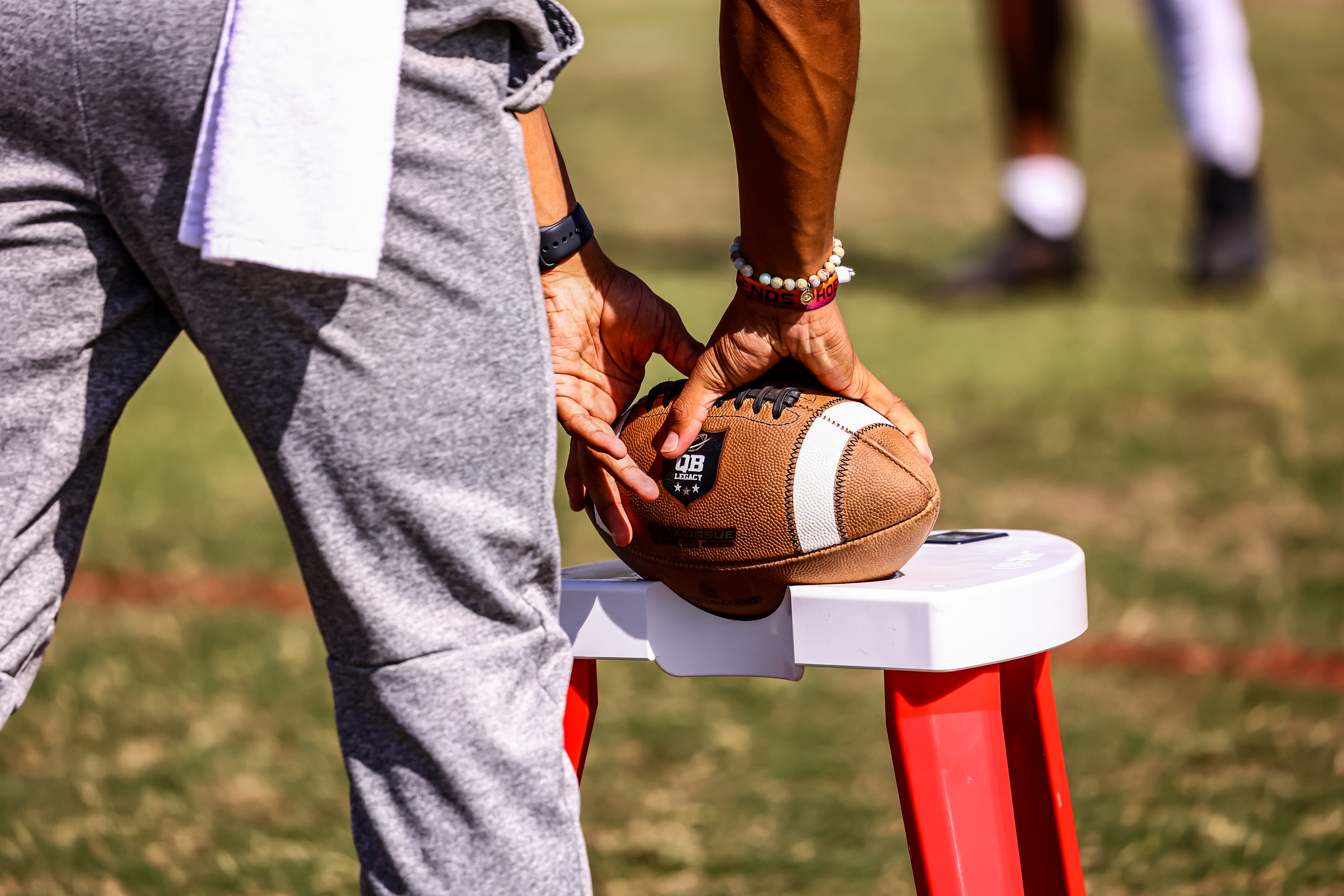
Christmas has passed, and as the calendar prepares to turn to the new year, it’s important for athletes and parents alike to remain vigilant.
What exactly do I mean by that as it related to Arizona high school football — and sports in general?
We see it every year. Club 7-on-7 teams ramp up in January. Recruiting services begin making phone calls, sending DMs and posting ads on social media promising to land offers for athletes. “Bowl games” are also something that has come to light more and more in recent years.
I’m not here to trash on those things. To each their own. But, I am here to share what I have learned over my near decade covering high school sports. All of this has come through conversations with high school and college coaches, as well as members of the media well-versed on this side of the fence.
Everywhere you look, recruiting services are there. Some provide simple data, such as top speed in games and other measurables that college coaches actually find helpful in the recruiting process.
But others simply provide “analysis,” if you can call it that. One or two sentences about how a player is “explosive” and “athletic.” Then they often share their thoughts: “He would be great at the next level!!”
So, what exactly did they tell us? Nothing. Nothing at all.
And mind you, some of those recruiting services that provide that expert level analysis charge hundreds, if not thousands to hopeful parents and athletes.
“My stance on recruiting services has never changed,” said Cody Cameron, a respected member of the Arizona high school football media who specializes in recruiting. “I personally do not think a high school player needs to spend money on a third party to get recruited. Friday game film, a high GPA, track times, and college ran evaluation camps (not the Alabama’s of the world, but ones with multiple D2, D3, NAIA staffs on-site) will get you recruited.”
I had a conversation a while back with a parent who was asking me my thoughts on a specific recruiting service. I will not name it here.
Their questions were simple: Is it legit? Do they really have connections? Can they get my son to the Division I level?
My first question back was why they hadn’t talked to the player’s head coach. That is the first person a player should go to for recruiting advice. Sure, the recruitment service in question has connections. They’ve been in the game for a bit and have had many clients go play at the next level, but mostly Division III or NAIA.
There is absolutely nothing wrong with that. College football is college football. But getting recruited to major schools doesn’t come from who you have representing you or sharing your film on X with multiple fire emojis. It’s about skill.
Unfortunately, the number of athletes that go D1 is slim. The number of athletes that go D2 is also slim. D3 and NAIA is the same way. And when you’re recruited by smaller schools, you have to have the grades, too.
Small colleges don’t have thousands to throw at athletes for scholarships. Most are partial, and they rely on academics to fill in the gaps.
That’s why reputable media members and coaches will always emphasize that their players are student-athletes. Grades matter. And unfortunately for this parent I spoke with, grades were an issue.
No recruiter in the world will get someone a major college offer based off their word. I don’t care how many emojis they use on X or how “connected” they make themselves out to be. If you don’t have the grades, don’t expect offers. Simple as that.
That’s the biggest issue I have with recruiting services. They make false promises, collect thousands of dollars and think their work is done when something like a preferred walk-on is offered or an “offer” from one of the “junior college” programs in Arizona.
News flash: Those are not real junior college football programs. It’s post-grad.
Some recruiting services provide worthwhile data. But those companies aren’t connecting with every player in the state. According to Cameron, your best chance of getting recruited is by going through your head coach. Your next best chance is reaching out yourself.
“Your high school football head coach will be your No. 1 point of contact,” Cody said. “He can tell a college coach the honest truth about your work ethic in the weight room, the class room and the practice field. Not somebody who you are paying lots of money to that lives hundreds of miles away. My advice to all families is just to do your homework.”
College coaches would much rather be contacted by a player advocating for themselves than a 40-something-year-old that lost all athleticism but claims to know the ins and outs of football and recruiting. Be smart about it.
“Just because I think one way doesn’t mean you need to,” Cody said. “If you see value in it and want to pay for help, by all means go for it. Just make sure you’re calling references before spending any money.”
Club 7s
This part is going to ruffle some feathers so I’ll keep it short-ish.
Club 7-on-7s is a cesspool for bad practices and is driven by massive egos that have no business coaching high school kids.
In my career, I’ve been to one club 7s event. I was there for 20 minutes before a fight broke out. I was there for 25 minutes before I saw two parents yelling at each other, then at opposing players. Five minutes later coaches go into it.
You can claim its competitive, sure. But when coaches are arguing with parents and fights ensue, it’s not good for anybody involved.
Club 7s has become popular across the nation. I get it. Companies like Battle have dumped tons of money into it. I respect them. But people involved make it one of the most hated off-season activities for high school football players.
Parents don’t know how to control themselves. Coaches are terrible examples and are just trying to relive their lackluster careers through the top athletes they recruit.
Now, I will say this does not include every coach or club 7s team. Tucson Turf has been around for years and from my experience, always seems to be one of the more professionally run organizations.
Maybe if others decided to go off of their model they would get more coverage. But again, egos.
Nine of out 10 high school coaches would encourage their athletes to run track instead of play club 7s. You don’t get recruited based off club 7s film. The football in general isn’t real. Giving a quarterback three seconds to stand comfortably in the pocket is much different than having three seconds with defensive linemen bearing down on you.
Catching a pass in the open field and only having to worry about being touched isn’t real either.
Cody’s opinion on club 7s is similar to mine, especially when players skip school-organized activities or opportunities to improve grades for a 7s tournament.
“I think where I struggle with it so much is I’ve seen a lot of players who skip team workouts, lifting sessions and track to go to their club 7s events,” Cody said. “Even worse, I talk to coaches all the time who tell me a lot of those kids have (bad) grades.
“If you are serious about playing college football in this era, you will never skip a chance to raise your GPA to play in an offseason club 7s event. Same thing goes with Track. The 100-meter time and shot put distance will forever trump a club 7s highlight in the world of college football recruiting. And if you don’t think so, go look at the players who are getting recruited.”
Let me be clear. Similar to Cody, I don’t blame kids for participating. They just want to be competitive. I blame the parents and coaches who have made it so toxic that most media members won’t cover it unless parents are shoveling out hundreds of dollars for pictures or videos.
Some may be asking if I feel the same way about the summer 7s season for high schools. Sort of but not really. It’s more professional. It’s sanctioned. It has local colleges involved.
How many times has Kenny Dillingham approached a player during a club 7s tournament? Exactly. And even if he does approach players at the ASU 7s tournament they put on for high schools during the summer, it’s because they’ve already seen film from real football and they want to see the player in person.
“When all these college coaches come down to Arizona to recruit this January, go ask your high school head coach what they are asking him about,” Cody said. “They will be asking about grades, game film and if a kid is out for track or another sport. Playing offseason 7s can be great, but don’t lose opportunities to get better grades and build bonds with your high school teammates in the weight room and track because of it.”
People will probably think I’m the “get off my lawn” guy for this. That’s OK. There are many people who feel the way I do. I’m just thankful I have the platform and voice to share it.
Moral of the story is this: Be vigilant and make smart decisions. Trust your high school coaches. They want what is best for you. They don’t want to put you in a situation where shelling out thousands of dollars will get you nowhere.
Trust the process. Do well in school. Market yourself in a way YOU want to be marketed to college coaches. At the end of the day, it’s all about how you carry yourself and the activities you become involved in.
Have a safe New Year.


Leave a Reply